


 It would be quite impossible for me to write anything about Giuseppe Gambino without going back to the days when I first knew him. It is more than eighteen years ago yet the recollection of what he was then has always remained so vivid that I could never have forgotten him even if chance had not brought us together again after so many years.
It was in the summer of 1944, in the middle of war; Gambino’s father was with me, employed in taking care of a temporary deposit of works of art which had been stored in the castle of Guiglia in the Modena Appennines. The situation was dramatic to say the east of it. We were left entirely to ourselves with the responsibility of a priceless collection among which were the entire contents of the Este Gallery. Around us there was chaos and despair, with the continual affrays between partisans and Germans, searches among the population, summary executions, vendettas and war.
The war, that is to say the front itself, was in fact, not very far away, and the cannons thundered especially at night – those sleepless nights at Guiglia with suspicious silences which were often broken by sudden bursts of machine –
gun fire and screams of terror.
It was at that time and under those conditions that I met him. He was little more than a boy, small, dark, delicate, even emaciated, with bright burning eyes. I felt that he was all concentrated upon a reality so tragic, so much bigger
than him – and us too – almost as if he was incredulous about what was happening, yet neither bewildered nor frightened, but filled, instead, with a profound humanity and disposed to forgive the men who compelled him to grow up in that hell, for no fault of his own, while he seemed, at the same time, to be asking why it was all happening.
He was not talkative or fond of company. Although we passed our days so close together, almost rubbing shoulders as it were, I seldom saw him. He used to withdraw as soon as he could, to climb up to the tower and gaze out over the immense panorama beyond which, on clear days, could be seen the whole of the Po valley from the slopes of the Appennines right to the Alps which shut in the horizon to the north. He used to remain there by himself, to think, perhaps oblivious of what was going on round him. Perhaps the evidence of these evasions is still there in one of the rooms in the tower, where I once saw his name written in big letters on the broken plaster of the walls.
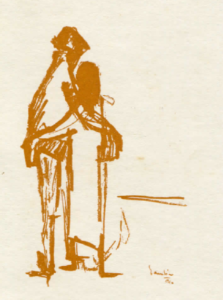
But these evasions were not only contemplative, even with so many reasons for anxiety and the awareness of death which brooded over us. He had started to paint, figures and landscapes. I remember yell how his father used to show me, certainly without his boy knowing it, sheets of paper of various sizes on which he had drawn certain images — in pastel or watercolour I think — in firm, almost violent outlines with a predominance of brown and burnt colors which he still uses today.
At Guiglia, in those days, we had other things to think about than studies; going to school was not even mentioned, but Gambino used to read and most of all draw. This constituted a singular, even exceptional case, in that world of angry or despairing people compelled to live realistically from hour to hour, that little bit of life which everyone hoped might be granted to him. The worst experience he had to undergo in that period was that of burying the dead. The Germans had set up a field hospital beside the castle where wounded soldiers were brought from the front. It was not unusual for them to arrive dead too. Gambino, together with other boys of fifteen and twenty, was obliged to dig graves close by the village cemetery to put them in, accompanied by bursts of rifle fire. This job lasted for a long time and must certainly have had its influence on his sensitive spirit and his body which felt it deeply even long after the war was over.
Circumstance afterwards separated us. I did not see him again for a long time and only heard of him from time to time. When the war was over his father wanted to return to his native Sicily and so distance attenuated, or rather completely broke off, our connections.
In 1954, about ten years after the incidents I have described, I ran into him by accident in the Bocca di Piazza in Venice. He was poorly dressed, and worn looking, but his eyes were still shining and even gay. I recognized him at once of course and asked him what he was doing and so he told me his story. As he grew the attraction towards painting had became stronger and more urgent. His father, perhaps worried about his future, would have liked him to study and train for life with a less risky profession but he was already doing his best to make a name for himself. A small show or two, one or two posters, had all confirmed his idea, which had first sprung up in him when he was at Modena, and at Bologna, where he had gone to live by himself with occasional visits to Monreale where his parents lived, that painting and only painting, was to be his future profession. Relationships between father and son were broken and so at the age of little more than twenty-five, without a penny in his pocket and only the suit he was wearing to clothe him, he had left home and come to Venice the city of painters. What prospects had he and what patrons? Absolutely none – only his love for art and the firm decision to go his own road in the knowledge that now it was impossible to turn back.
Forgive 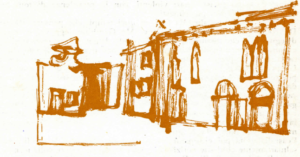 me Gambino if I confess here that my help in organizing your first show in the autumn of 1954 – almost completely improvised – was not only from the conviction of the validity of your work. What moved me was, above all, his faith, his going forward at random without any certainty but the one of obeying his own conscience, thus giving proof of a deep seriousness which I had been aware of even in the days at Guiglia, and a constancy for which he was paying dearly by putting himself in so dramatic and insecure a position. All alone, without aid of any kind, he had the look of a man who had gone without food and who, at night, had nowhere to sleep except in some solitary boat abandoned in one of the silent canals of the city. But he did not despair and he did not look it; he asked nothing and did not try to move me by his story. He only said that he was happy – that he was could be read on his face – because now he could give himself up to painting, he could get on with his work without any hindrance, free, completely free to do at last what he wanted to do, quite sure that he would find in artistic creation that moral independence which had sustained him during the War also, and which had saved him from the horror of it and had kept him immune from human spite, and which had given him that serenity, or rather joy, in life, to which he owed his escape from so many physical and moral misadventures.
From his v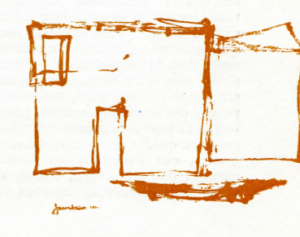 ery first works Gambino showed that he knew what he wanted. He does not grope in search of a formula, cunningly attentive to what is going on round him, neither is he ready to adopt fashions in painting which are not his own especially when they are successful. Having chosen his own way he goes on with apparent ease and his style becomes always more personal, sure and unmistakable. It must be admitted that he has never tried to join up with other artists, to enter a group or form part of a current. He has done all his work alone; he has lived and « suffered» in the knowledge that if there was one word he could say to other men, he would find it within himself and not with the collaboration of other people. No-one, I think, will find the word «suffered» too strong, referring as it really does to a circumstance and human condition which is all the deeper and more genuine because it has never been expressed outwardly by the man himself. His world can already be perceived, although not, I should say, clearly definable, in some of his Sicilian paintings done before he came to Venice. It is his own particular world, the nascent fruit of his human experience, so that it distinguishes him and singles him out from among contemporary Italian painting. All this is owing, clearly, to the fact that painting for him is not an adventure or another way of flinging oneself into life, but rather an irresistible movement of the spirit which has urged him to go on and on working at his search for the best way – that is the most direct and elementary one – of saying those things he feels within him.
I often wonder how far his tormented youth has influenced his work. That drawing and painting meant for him an almost undeniable way of giving meaning to life day by day, right from the beginning, is quite certain. But what did this mean? Was it an escape, a desire to forget, in other words the taking up of a position of renunciation, or perhaps an eager search to explain to himself all that was going on round him? And in this thinking over was he not gradually forming and fermenting in his consciousness, a feeling of pity, a limitless love, and for this reason, anguished, for his fellow men, as a necessity of life, as a way of overcoming that terrible chaos, that horror which had involved everyone, so that he had had to shut himself up and seek in line and color the means to give form to that sentiment which urged him from within and asked to explode in some way and to make itself heard? The horror within him was overcome by pity and this pity embraced everyone, the oppressed and the oppressors, the conquered and the conquerors. Perhaps those dead bodies he had buried had suggested the conviction born from an infallible intuition, of the terrible and absurd uselessness of what had happened and had opened his heart to that feeling of pity for all humanity. From this moral situation, his first works I believe, were born, by then conscious and connected by a thread never to be broken, to his present work. I remember certain impressions of Sicilian landscapes already conceived in that isolated and closed way, developed to concentrate the scene without any possibility of evasion. In the same way many of his drawings accentuated this stylistic vigor, fixing his lean figures in clear and controlled composition. The series of beggars, poor folk who look without speaking, without shouting, born always within the limits of an essentialness. that, excluded and annuls every illustrative character and search for facile sentimental emotion. But that world is full of an internal strength which is released and reveals to what extent the transposition of a reality that has been seen and lived into a lyrical fact, has been meditated upon. Those poor folk, shut up within their world which seems the only possible one for them, ask first for love and then for bread, with an emotional violence suggested, I repeat, not by an evident and forced descriptiveness, but by an interior sentiment which is imprisoned within those gaunt outlines. Gambino’s «denouncement» is not a social one, it does not imply an accusation or an adherence to this or that political current; it is only human and therefore universal. Life has not been gentle with him; the dangers and hardships and the memory of the happenings lived through in his childhood will never be wiped from his memory, but the terrible wounds which his young and sensitive spirit received have carried him, not along the road towards hate but up the one of love. I would go even further; his is not a rebellion against a dark and sad human condition either. There is, instead, a feeling of eager participation in his being, and it is so when he paints certain forlorn human creatures and those «lovers in the outskirts» closed in their loneliness, beings isolated in an impossible space, whom he follows and watches with understanding and tenderness.
 Perhaps Perocco saw rightly when he remembered «some affinities between the sentimental poetical world of De Sica and Zavattini, and certain paintings by Gambino. Remember the last shot in «Bicycle Thieve » when father and son walk away holding hands, or those shots of the anonymous outskirts of a great city in «Miracle in Milan». The poetical situation is analogous.
But it is necessary to add that Gambino’s art can acquire its rarefied lyrical intensity just because of the human sentiment it contains, hidden in him, in the apparent silence of the sober composition and color immersed and closed within the limits of the design. The vitality of his painting lies precisely in this control which he knows well how to impose on the form, in that fusing of his emotional exuberance in to abstract and almost immobile spell of the images heightened beyond reality, isolated and placed outside the world of which we are aware. In consequence the emotion does not come from without but springs from within, appears and stirs always a little more, retracing almost the way road covered in reverse by the impetuous sensitiveness of its author who has been able to restrain the sentiment so as to guide it towards the form which means nothing if it is not born from a content, if, that is, it is not understood as a visible revelation of what the artist has in his mind. This is Why, just as content without form does not belong to art, in as much as it would be equal to the objective transcription of the apparent reality, intelligible or as a phenomenon in the same way it is not possible to have a form which is not a manifestation of a content, that is to say, of a sentiment filtered by reason, or at least, one which is not the result of an uncontrolled and unconscious, and therefore casual, activity. But in this case we are no longer within the artistic situation because creation must be a conscious, meditated, or even suffered, act.
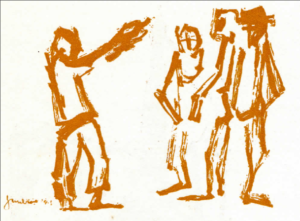 The «Girl with the lantern», «Strolling», «The young priests», «The engaged couple», are all interesting aspects of Gambino because of the humanity which surrounds him and with which he identifies himself. They seem beings outside time, because the references to reality are excluded, but this makes universal what he concedes to us in his discourse. His creatures ate born from that deeply felt love for forlorn, misunderstood humanity, resigned and sad. His long experience of drawing allows him to make these creatures – elongated without bodies, devoid of all modelling – stand out on. canvases without space and perspective but without violence. The color animates them in a minor key and only here and these does it brighten and eaten shine in tints made more precious by their relationship with the rest of the design; startling greens and reds, which stand out more sharply on their contact with the brown and grey-white spread over the backgrounds.
At the same time as figures, Gambino is also interested in the things about him; he reads history in them, the continuity of time, the eternal flow of the seasons. Those Venetian scenes, freed from any kind of illustrative character, or empty sentimentality, were born in this way, severely controlled even in the color which becomes even more sober and modulates between browns and greys with a few tenuous concessions to more charming vibrations.
The subjects are not so much whole visions as separate buildings, or architectural sequences isolated and placed outside their context as elements in a city, outside the landscape, in short outside time.
Look for example at his «Procuratie Vecchie»; the urgent rhythm of the architectural elements reduced to their essentials, enclosed in the shape that simplifies them and withdraws them from reality, recalls certain Byzantine compositions, for example, the-rows of saints and virgins on the largest wall of Sant’Apollinare Nuovo at Ravenna.
The same applies for all the other innumerable aspects r of the city which Gambino has put onto his canvases. They are always closed elements which proclaim his insistent penetrating into visual reality to the point of destroying it, to see and understand what it is concealing. He penetrates like this, into the world of things not as he has done and continues to do into those of beings, to reach this discovery of the privacy or rather the interior and hidden ferment of spiritual vitality, born from its secret intercourse with all that surrounds it.
It has not escaped a shrewd critic like Apollonio that Gambino’s position, which tends to discipline, rather than to translate, reality into a series of isolated images by now outside all direct contact with it, is by now ripe for a complete surrender to abstract art. His words, indeed, have no other meaning when he says that «his (Gambino’s) manner, although not involved in the much discussed and acute demands of the present conditions of art, is nor indifferent to them and it is already apparent that it is touched by them and is drawing near to actually taking part, with its own reasons and its own motives». It was an invitation to take the final leap, yet Gambino is able to hold back, and without letting himself be tied to anyone, has been able to resist the siren charms of abstract art; because he has understood that if he listened to that voice which is not his own, he would be finished – finished, I mean, as regards painting. In fact the best and most obvious way to be present at modern artistic conditions is to continue to listen to one’s voice and not to that of others; to shun, that is, the charms and attractions of a direction which does not respond to one’s own sensibility and which would mean ending by becoming literary and academic, and throwing oneself into the dangerous spirals of the breathless search for novelty at all costs, it being impossible to give form to a content, just through giving up, I should say suicidally, working by oneself. These best way to be modern, say what they may, is just that of remaining oneself, of not renouncing one’s own personality; in other words, of not destroying the creative fact which is dictated by the spirit, to follow – through the baseless fear of feeling that one has been outmoded – the ways of other people and so transforming one’s art – of there is any there – into literature. The weak ones and the ones who have no confidence in themselves do it. Above all whoever renounces his own ideas runs the risk of being pushed to the wall and ending up among the sandbank‘s and backwaters.
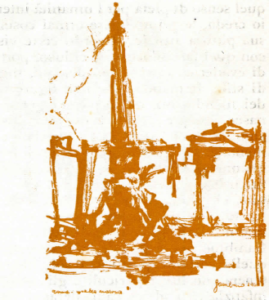
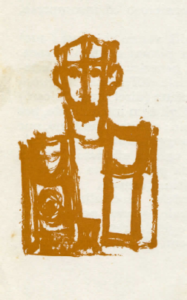
So Gambino has gone on creating and – forgive me for quoting from Dante what is so apposite – observing and proclaiming «in that way which is dictated. from within» the love, that is, according to his inspiration, and not according to reason which must, of course, control, and I would also say, filter the sentiment but which cannot substitute it. And so he passes from the facades of the Venetian houses to other thémes, enlarging his creative possibilities and thrusting his interest toward wider horizons which spurred him to keep awake, beyond all possible reclaiming, his sensitiveness. There are figures, portraits, imaginary creatures and sacred objects, all relived by him, in absolute independence and freedom from every iconographic suggestion. Look at his «Annunciation» which several years ago, won the Bevilacqua prize in Venice, or his «Crucifixion», which won a prize at Bologna, or lastly those «Recollections of Spain», men and things, landscapes and suggestions which are among his strongest and most significant works especially for their color which is unusually violent. In his still lifes the objects lie abandoned in great backgrounds disposed in sharp blocked out masses of color without impasto, in such a way that these poor objects appear alive and forlorn without remedy, left to themselves as they are in middle of many other useless, or worse than useless, things which we ignore or neglect. The dominant theme in Gambino’s painting is just this feeling of solitude, this bitter and disturbing emblem of our civilization, but of course, he feels it in his own way. His problem is not born from a conscious impossibility to speak out, by a renunciation through incomprehension, or even a refusal, but rather from the conviction of a casual fatality. From this ardent desire for a possibility of meetings, is born the only hope of achieving an understanding with other men. This is the reason why Gambino, instead of arousing despair, of throwing one into pessimism, offers hope and urges us to believe in the goodness of life. He is, then, outside all contact with social realism and yet avoids the tragic pessimism of the informal spirit of consubstantiality; a pessimism through the impossibility of reaching an understanding or the. beginning of a hope. I would not say that there is irony in his work, as has been observed, or that he allows himself to be led away by his subject. If there is a painter today who is able to control his artistic vision and to abstract it from realism, it is Gambino. Indeed I have always thought and still think that, besides the bleak natural mountain and human landscape which broods over Monreale, the Byzantine mosaics also of the celebrated basilica over which he must have meditated for long, a thoughtful, misunderstood youth, during the long years passed there, must have had a great influence over his artistic formation.
It is there then, as well as in his youthful meditations, that his precedents must be sought, and not in some personality of contemporary painting. The name of Bernard Buffet has. Been mentioned. Apart from a generic and completely external assonance of manner, there is a substantial difference between the two men. The French painter, who constructs his pictures with a faked (I would say prefabricated) and all-purpose line, does not feel the force of the play of color. He is an intellectual, so to speak, and follows reason and, if you like, calculation, while Gambino, well aware of what is happening around him, does not allow himself to be influenced either by calculation or weakness and continues to follow sentiment. In this way he has grasped the best way to live in history and to take a leading part rather than that of a walker-on, or member of the chorus, in the action of modern painting.
He knows the conception of fidelity, fidelity that is, to his own conscience, not so much, I believe, from an imperative moral sense, as for a creative necessity which leads him to respect others. In any case he does not belong to the category, today very large, of intransigent artists, who do not admit that it is possible to think in a different way from them. Today, not only in politics but also in art absolutism flourishes especially among critics who are ready to change their opinion with a facility that leaves one perplexed to say the least of it; they quarrel with those who are not of their opinion, insult them and proclaim them reactionaries and failures only because they do not conform to their own ideas, and as a result many who are unprepared adventure along new ways without knowing where these will lead to.
 Painters often allow themselves to be guided by the critics and philosophers who theorize, urged by their implacable and incurable «logic» which does not always arise from «logical» premises. They theorize, goaded by all that is happening in the world today, with hydrogen bombs and space ships, in the anguish of an existence lived out on a razor edge.
But in spite of all, the daisies spring up in the meadows. Their presence is always more moving and certain, and, if we like, we owe it to them if life is still worth living. Even the daisies then have their importance and no-one has the right to cancel them from the history of nature and painting. Gambino is one of those – I may be mistaken but I think so – who still believes in the wonders which creation offers us day by day.
He has traced his own road alone; his sufferings, his human experiences, his desire to live, have all prepared him’ for it. Suffering has thrust him, not towards bitter «denunciation» but rather towards human solidarity, compassionate and loving, towards the World around him and of which he feels a living part. This does not exclude a protest against certain conditions, but it does not spring from that violence which renders inflexible the feelings and creates hate, but from a profound and irresistible urge towards comprehension. It is precisely in this triumph, in this desire to enlarge his own radius of humanity and to let others participate in it that the poetical substance of his painting lies, it seems to me. Not sentimentality, but pure and controlled sentiment, born from experience, fruit of an awareness of a human situation which he knows how to dominate, looking at everything with the feeling of one who knows and understands the miseries of this daily life of ours.
pietro zampetti
This entry was posted on Friday, December 2nd, 2016 at 13:26
You can follow any responses to this entry through the RSS 2.0 feed.
Posted in: About Gambino